
What Do the First Three Months Look Like?
Month one is survival and vocabulary: you learn the names of positions and spend most of your time being controlled. Month two, the panic drops and you start remembering what to do. By month three, you are defending things that used to catch you every round. Nothing looks impressive yet.
That is the honest arc, and it is worth saying out loud, because the version of jiu-jitsu that exists online is all finishes and highlight reels. The real thing is slower, smaller and considerably more enjoyable than it sounds.
Week One: The Part Nobody Warns You About
The first class is mostly noticing how much you did not know you did not know. You will be told to keep your elbows in roughly forty times. You will forget to breathe. You will be tired in a way that has nothing to do with cardio and everything to do with tensing every muscle you own for five minutes at a time.
This is universal. Every person on the mat had exactly this week. If you want the full walk-through of a first session, we have one in what to expect at your first BJJ class.
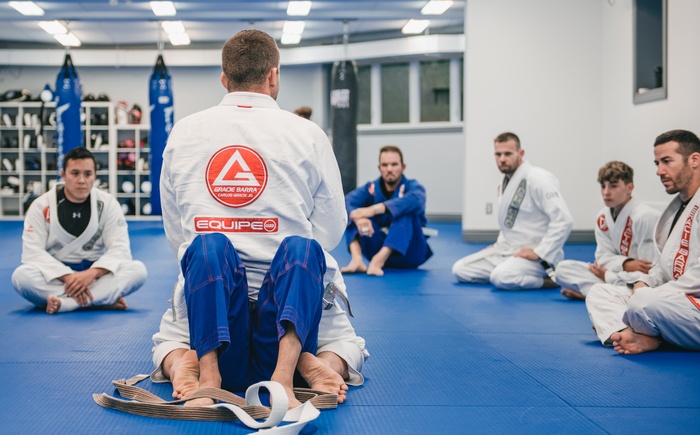
Month One: Learning the Language
The first month is not about getting good, it is about the room stopping being confusing. Guard, mount, side control, back. Once those four words mean something to you, a coach's instruction stops sounding like a foreign language and starts being usable in real time.
You will lose every round in month one. That is the correct outcome and not a signal about your potential. What you are actually building is the ability to notice where you are, which has to come before anything else.
Month Two: The Panic Drops
Somewhere in the second month, most people notice that being underneath someone stopped feeling like an emergency. Nothing about your technique changed much. Your nervous system just stopped treating a bad position as a crisis, which frees up enough attention to actually think.
This is the single biggest change in a beginner's first year, and it happens quietly. People rarely notice it on the day. They notice it about a month later, when they realize they have not been holding their breath.
Month Three: Defending Things
By the third month you start stopping things. Not finishing them, stopping them. Someone goes for the same collar grip that has caught you eleven times and this time your hand is already there. It is a small moment and it is the one that makes people stay.
The Small Wins That Arrive First
- You stop being sore in week three. The first two weeks are rough. Then your body adapts and it is just exercise.
- You learn everyone's name. Which sounds trivial and is not, because it turns a gym into a room you look forward to.
- You sleep better. Reliably reported by almost everyone who starts training in the evening.
- You tie your own belt without thinking. A real milestone, and faster than you expect. Our belt-tying guide covers the knot.
- You stop apologizing. New people apologize constantly. Around month two it stops, and that is confidence arriving from the side door.
How Often Should an Adult Beginner Train?
Two classes a week is the sweet spot to start. Frequent enough that each session builds on the last rather than restarting, light enough that your week can absorb it. Three is better once your body has adapted, and there is no prize for four in the first month.
At Gracie Barra Manotick, the adult fundamentals class runs Monday and Wednesday at 7:15 PM and Tuesday and Thursday at 8:15 PM, so two nights a week is easy to pick out of the timetable. There is also a Saturday morning open mat from 9:00 to 11:15 AM once you want more time on the mats.
Progress in jiu-jitsu is not a curve. It is a flat line with occasional steps, and you only see the steps looking backwards.
What Actually Makes People Quit
It is almost never the training. It is scheduling. Someone misses two weeks for work or a cold, feels behind, and never rebooks. The way through it is unglamorous: pick a fixed night that genuinely fits your week, and treat a missed class as a missed class rather than a verdict on whether you are a jiu-jitsu person.
The second reason is comparison. There is always someone better, including on your first day and on your last. Measuring yourself against the person you were three months ago is the only comparison that ever produces anything useful.
Starting in Manotick
Gracie Barra Manotick runs adult Brazilian Jiu-Jitsu for ages 13 and up at 5700 Longshadow St, with a fundamentals path built specifically for people who have never trained. Most of the adults in that class started exactly where you would.
Have a look at the adult BJJ program or the full weekly schedule, then book a free trial. Turn up in athletic clothes, arrive ten minutes early, and let a coach know it is your first time.