
What Does Kids Muay Thai Actually Teach?
Kids Muay Thai teaches self-control before it teaches striking. A child learns to stop on command, wait their turn, listen through noise and repeat something they have not mastered yet. The punches and kicks are the delivery mechanism. What parents notice at home is the attention span and the calm.
None of that is on a poster, because "your child will get slightly better at waiting" is a hard sell. It is also the thing most parents end up valuing most.
Stopping on Command
The first real skill in any kids striking class is not a punch. It is stopping the moment a coach says stop, mid-movement, without finishing the thing you were enjoying. That gets drilled dozens of times in an hour, cheerfully and without drama, because the class cannot function otherwise.
For a seven-year-old, doing that reliably is a genuine act of self-regulation. It just happens to look like fun.
Listening in a Loud Room
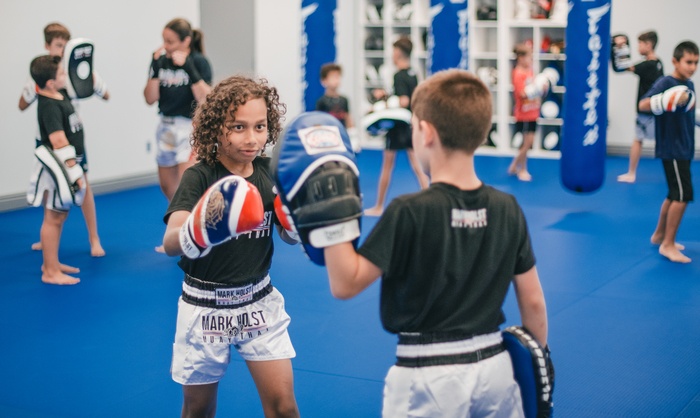
A martial arts room is busy. Pads snapping, twenty children, a coach giving one instruction to the whole group. A child has to pick their coach's voice out of that and act on it, which is a different skill from listening in a quiet classroom and arguably a more useful one.
Being Bad at Something on Purpose
Every new technique is a short spell of being visibly not good at something in front of other people. Children who are used to being praised for things they already do well often find this genuinely uncomfortable at first, and then, within a couple of months, they stop minding.
That shift is the most transferable thing on offer. It shows up in homework, in music practice and in anything else where the first attempts are bad by definition.
Does It Make Children More Aggressive?
This is the question parents ask most, usually a little apologetically, and it deserves a straight answer. In a coached class the opposite is the usual outcome. Children spend most of the hour being told when to stop, when to wait, when to reset and how hard is too hard. The strongest habit the class builds is control, not force.
There is also a rule that gets stated out loud and often: what you learn here does not come out at school. Striking outside the academy is treated as a serious rule break rather than as enthusiasm, and children take that framing seriously when it is applied consistently.
The pads are the reason a child comes back. They are not the reason it works.
What Parents Tend to Notice at Home
- A longer fuse. The gap between frustration and reaction gets a little wider.
- Better sleep on training nights. Reliably reported, and not complicated: it is an hour of hard movement in the evening.
- Posture and balance. Stance work is constant, and it carries.
- A willingness to be corrected. Being told "again, but with your hands up" forty times a week normalizes correction.
- Pride in something specific. Not a trophy. A kick they could not do in September.
What It Will Not Fix
Worth saying plainly, because overselling this helps nobody. Martial arts will not resolve a serious behavioural or emotional difficulty on its own, it is not a substitute for professional support where that is needed, and it will not make a shy child outgoing on a schedule. What it reliably provides is a structured hour, a consistent adult, clear rules and small visible progress. Those are real, and they are not everything.
It is also worth being realistic about weeks four to six, when the novelty fades and some children want to stop. That is normal. Usually the answer is turning up anyway for a couple of weeks rather than a conversation about commitment.
Kids Muay Thai at Gracie Barra Manotick
Kids Muay Thai runs Monday through Thursday at 6:30 PM at 5700 Longshadow St in Manotick, in age-grouped classes for roughly ages 6 to 13, with an advanced stream for children who want more. Classes are taught on mitts, pads and bags, and children do not spar.
If your child is younger, jiu-jitsu is the usual starting point: our Tiny Champions program takes students from age 3, running daily at 5:00 PM and Saturday at 10:00 AM. If you are weighing the two arts against each other, our guide on BJJ or Muay Thai for your child covers that choice properly.
Otherwise, see the Muay Thai program, kids BJJ or the full weekly schedule. The first class is free, and you are welcome to watch it from the side.